
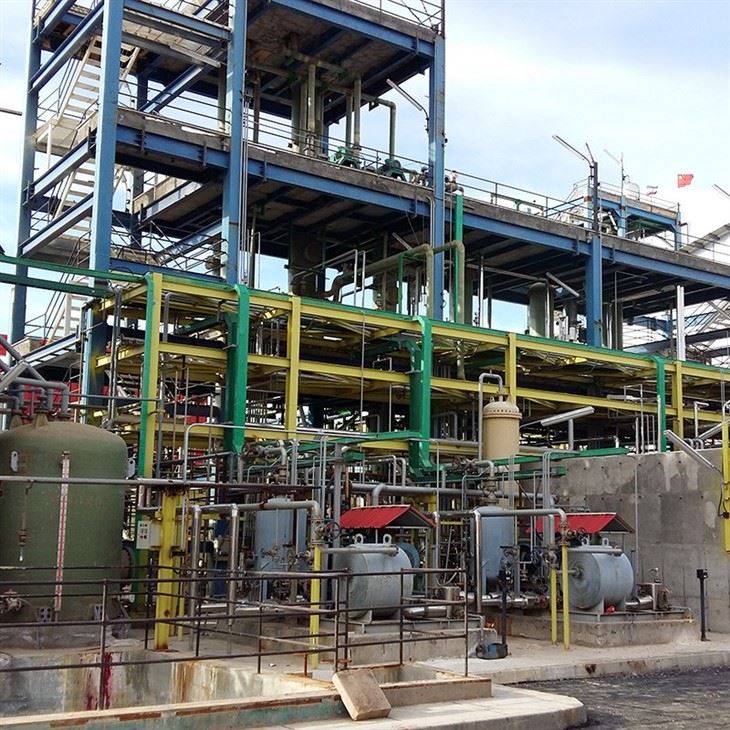
Asia Chemical Engineering Co., Ltd. is one of the most reliable manufacturers and suppliers of membrane electrolysis caustic soda plant in China. Please rest assured to wholesale cost-efficient membrane electrolysis caustic soda plant from our factory. Good service and reasonable price are available.
Membrane Electrolysis Caustic Soda Plant
Technical Specifications & Operational Process
Working Principle of Membrane Electrolysis Process
The core membrane electrolyzer utilizes an ion exchange membrane between two chambers to allow sodium ions (Na⁺) to pass through while keeping chlorine and hydroxide ions separated, ensuring pure NaOH output.
Main Process Sections
1. Brine Preparation and Purification System
Prepares high-quality saturated NaCl brine. Removing impurities is crucial to prevent accumulation and performance drop on the membrane.
Equipment: Salt dissolving/brine storage tanks, chemical dosing systems, clarifiers, filters, ion exchange purification units.
Impurities Controlled: Calcium (Ca²⁺), Magnesium (Mg²⁺), Iron (Fe³⁺), Sulfate (SO₄²⁻).
2. Membrane Electrolyzer System
The core unit where purified brine (anode) and water (cathode) meet under DC power to produce Cl₂, H₂, and NaOH.
System Components: Anode/cathode electrodes, ion exchange membranes, cell frames, brine/caustic circulation, DC power supply.
Impacts: Current efficiency, energy consumption, product concentration, and production capacity.
3. Caustic Soda Concentration System
Evaporates water from the initial dilute output to achieve commercial-grade concentrations.
Equipment: Falling film evaporators, heat exchangers, steam systems, vacuum equipment, product circulation pumps.
4. Chlorine Gas Treatment System
Cools, dries (sulfuric acid system), and compresses anode chlorine gas.
Applications: PVC, hydrochloric acid, sodium hypochlorite, water treatment.
5. Hydrogen Gas Treatment System
Collects cathode hydrogen through separators, cooling units, and pressure/safety devices.
Applications: HCl synthesis, chemical manufacturing, industrial fuel.
Key Equipment & Operations
| Process Section | Main Equipment |
|---|---|
| Brine Preparation | Salt dissolvers, purification tanks, filters |
| Electrolysis | Membrane electrolyzers, rectifiers |
| NaOH Processing | Evaporators, circulation pumps |
| Chlorine Treatment | Coolers, dryers, compressors |
| Hydrogen Treatment | Separators, cooling systems |
| Storage | NaOH tanks, gas handling systems |
| Automation | DCS control system |
| Utilities | Steam, cooling water, compressed air |
Material Selection for Corrosion Resistance
Operating Conditions
| Parameter | Typical Range |
|---|---|
| NaOH Concentration | 45–50% |
| Raw Material | Purified NaCl brine |
| Main Energy Input | Direct current electricity |
| Production Mode | Continuous operation |
| Process Type | Membrane electrolysis |
Production Capacity Range
| Capacity (TPA) | Application |
|---|---|
| 10,000 TPA | Small chemical production facility |
| 50,000 TPA | Regional chemical plant |
| 100,000 TPA | Industrial-scale chlor-alkali project |
| 200,000+ TPA | Large integrated chemical complex |
*TPA = tons per annum


FAQ:
1.How does a membrane electrolysis caustic soda plant work?
The plant uses direct current electricity to split purified sodium chloride solution in a membrane electrolyzer.
The process includes:
Purified brine enters the anode chamber.
Chloride ions are converted into chlorine gas.
Water in the cathode chamber produces hydrogen gas and hydroxide ions.
Sodium ions pass through the membrane and combine with hydroxide ions to form sodium hydroxide solution.
The membrane prevents chlorine and hydroxide ions from mixing, ensuring stable product quality.
2.What raw materials are required for a membrane caustic soda plant?
The main raw materials include:
Sodium Chloride (NaCl)
Used as the source of sodium ions and chloride ions.
Water (H₂O)
Provides hydrogen and hydroxide ions during electrolysis.
Electricity
Provides the electrical energy required for the electrochemical reaction.
The quality of salt directly affects membrane performance and plant operation stability.
Hot Tags: membrane electrolysis caustic soda plant, China, manufacturers, suppliers, factory, wholesale, price, profession, cost