

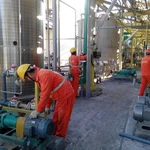
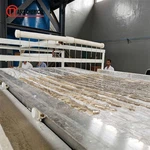

Asia Chemical Engineering Co., Ltd. is one of the most reliable manufacturers and suppliers of plants for sodium silicate production in China. Please rest assured to wholesale cost-efficient plants for sodium silicate production from our factory. Good service and reasonable price are available.
Production processes: There are two main methods: the dry method (solid-phase method) and the wet method (liquid-phase method). The dry method involves mixing quartz sand and soda ash in a specific proportion and heating them to approximately 1400°C in a reverberatory furnace to produce molten sodium silicate. The wet method uses quartz rock powder and caustic soda as raw materials. The reaction takes place in an autoclave under a steam pressure of 0.6-1.0 MPa to directly produce liquid water glass.
Equipment Components: Typically includes raw material batching, reaction, and filtration. Ancillary components may also include a caustic soda dissolution unit, water softening system, liquid raw material storage, finished product storage, and utility production units.
Product Uses:
Product Uses: Sodium silicate has a wide range of applications. Liquid sodium silicate can be used as an iron flocculant in wastewater treatment, a raw material for glassmaking, and a detergent builder. Solid sodium silicate can be used to produce silica gel and molecular sieves.
Performance Characteristics: Features include fast dissolution, good dispersion, and excellent frost resistance.

FAQ:
How can we avoid the two safety risks of autoclave corrosion and sudden pressure increase in the reactor during the high-pressure reaction phase of wet sodium silicate production?
In wet process production, the autoclave is the core reaction equipment (it needs to withstand 0.6-1.0MPa pressure, 120-180℃ temperature, and contact with strong alkaline medium). "Autoclave corrosion" will cause equipment leakage, and "pressure surge" may cause explosion. It is necessary to prevent and control it from three aspects: "equipment selection, process control, and daily maintenance": (1) Measures to avoid autoclave corrosion Select corrosion-resistant materials: The autoclave liner is preferably made of "316L stainless steel" (its alkali corrosion resistance is better than ordinary 304 stainless steel), or lined with "polytetrafluoroethylene (PTFE)" (completely resistant to caustic soda corrosion, suitable for long-term use); the flange sealing surface of the autoclave body is made of "alkali-resistant rubber gasket" (such as nitrile rubber to avoid alkali penetration and flange corrosion); Control the impurities in the reaction system: strictly control the purity of quartz sand (SiO₂≥99%) to prevent impurities (such as Fe₂O₃, Al₂O₃) from reacting with caustic soda to form hydroxide precipitates (precipitates attached to the autoclave wall will form "Under-scaling corrosion" accelerates damage to the autoclave. Filter the caustic soda solution (using a 5μm filter) before the reaction to remove suspended impurities.
Regular maintenance and inspection: Perform a "corrosion inspection" on the autoclave liner every three months (using an ultrasonic thickness gauge to check the wall thickness. If the thickness decreases by more than 10% of the original thickness, the liner must be replaced). After each reaction, rinse the autoclave with pure water (to prevent residual alkali solution from adhering to the autoclave for a long time) and allow it to dry before decommissioning.
(2) Measures to avoid sudden pressure rise in the reactor
Optimize reaction process parameters:
Control heating rate: Use "step heating" (it takes 1-2 hours from room temperature to 120℃, and then slowly increase to the target temperature) to avoid excessive heating, which may lead to a sudden increase in water vaporization rate in the reactor and a sudden pressure rise;
Control raw material ratio: Strictly follow the "NaOH to SiO₂ molar ratio of 2.0:1.0-2.5:1.0" (low modulus products) to avoid excessive caustic soda (excessive caustic soda will accelerate the dissolution of SiO₂, produce a large amount of H₂O, and indirectly cause pressure rise);
Improve safety devices:
The autoclave must be equipped with "double safety valves" (the main safety valve is set at 1.1 times the working pressure, and the auxiliary safety valve is set at 1.2 times to prevent the main safety valve from failing). The safety valve should be calibrated once a quarter (to ensure sensitive start-up);
Install "pressure transmitter + emergency pressure relief valve" and link it with the DCS control system: when the pressure in the autoclave exceeds the working pressure, the pressure in the autoclave will be increased. When the pressure exceeds 1.05 times, the DCS will automatically alarm; when it exceeds 1.1 times, the emergency pressure relief valve will automatically open (and close after the pressure is released to the safety pressure);
Hot Tags: plants for sodium silicate production, China, manufacturers, suppliers, factory, wholesale, price, profession, cost, solid sodium silicate equipment, wholesale water glass production line, Sodium Silicate Manufacturing Plant, solid sodium silicate equipment manufacturers, solid sodium silicate production line profession, Na2SiO4


