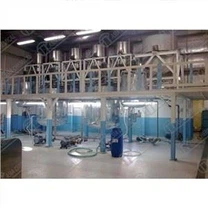
In sodium silicate production, modulus and concentration are two of the most important quality indicators. They directly affect product performance, applicability to downstream applications, and overall process stability.
Understanding Modulus and Concentration in Sodium Silicate
The modulus of sodium silicate determines its chemical behavior, solubility, viscosity, and reactivity. A lower modulus product contains relatively more sodium oxide, making it more alkaline and more soluble. A higher modulus product contains more silica, resulting in higher viscosity and different bonding characteristics. Typical industrial sodium silicate products range from a modulus of about 2.0 to 3.5, although some specialty grades fall outside this range.
Concentration, usually expressed as a percentage of total solids or as density at a given temperature, affects transportation efficiency, storage behavior, and application performance. Higher concentrations reduce shipping costs per unit of active material but increase viscosity and handling difficulty. Lower concentrations are easier to pump and mix but may increase logistics costs.
In practice, modulus and concentration are not independent. Adjusting one often influences the other, especially during dilution, dissolution, or neutralization steps. Effective control requires a balanced approach that considers the entire process flow rather than a single operating parameter.
Overview of Sodium Silicate Production Routes
Industrial sodium silicate is produced mainly by two methods: the dry process and the wet process. Each has different implications for modulus and concentration control.
In the dry process, silica sand and sodium carbonate (or sodium sulfate with a reducing agent) are melted in a high-temperature furnace to produce solid sodium silicate glass. This glass is then cooled, crushed, and dissolved in water under controlled conditions to produce liquid sodium silicate.
In the wet process, reactive silica sources such as precipitated silica or silica sol are reacted directly with sodium hydroxide solution under controlled temperature and pressure, producing sodium silicate solution without a melting step.
The dry process is more common for large-scale production and offers good flexibility in modulus adjustment through raw material ratios. The wet process is often used for specialty grades or where precise control and lower energy consumption are priorities.
Raw Material Control and Its Impact on Modulus
Raw material quality is the foundation of modulus control. In dry process plants, the purity and particle size of silica sand significantly affect reaction completeness and final composition. Variations in silica content or contamination with alumina, iron oxide, or calcium compounds can shift the effective modulus even if the feed ratio remains unchanged.
Sodium carbonate purity also plays a role. Inconsistent Na₂O contribution from soda ash can lead to batch-to-batch variation. Many plants rely on long-term supplier agreements and incoming material testing to reduce variability.
Accurate weighing and feeding systems are critical. Even small deviations in the silica-to-sodium ratio at the furnace feed stage can result in noticeable modulus shifts after dissolution. Modern plants often use automated batching systems with continuous monitoring to minimize human error.
In wet process plants, sodium hydroxide concentration and silica reactivity determine the final modulus. Controlling the reaction stoichiometry requires precise metering and consistent raw material quality.
Furnace Operation and Modulus Stability in Dry Process Plants
In dry process sodium silicate production, furnace operation has a strong influence on modulus consistency. The melting temperature, residence time, and mixing behavior inside the furnace affect how completely silica reacts with sodium compounds.
If the furnace temperature is too low, incomplete melting can leave unreacted silica, effectively increasing the modulus beyond the target value. Excessively high temperatures may increase volatilization losses of sodium compounds, leading to a higher silica-to-sodium ratio in the glass.
Stable furnace operation requires consistent fuel supply, proper burner adjustment, and uniform feed distribution. Temperature monitoring at multiple points helps operators detect deviations before they affect product quality. Some plants also analyze molten glass samples periodically to verify composition.
Cooling rate after melting can influence glass structure, which in turn affects dissolution behavior. Although cooling does not change the chemical modulus, it can affect how uniformly the glass dissolves, indirectly influencing concentration control during solution preparation.
Dissolution Process and Its Role in Modulus Adjustment
After solid sodium silicate glass is produced, it is dissolved in water to create liquid sodium silicate. This step offers an opportunity for fine adjustment of modulus, especially when additional sodium hydroxide or sodium carbonate is introduced during dissolution.
Adding sodium hydroxide lowers the modulus by increasing the Na₂O content relative to silica. This method is commonly used when producing lower modulus grades from high-modulus glass. The timing, dosage, and mixing efficiency of alkali addition must be carefully controlled to avoid localized concentration gradients.
Temperature plays a key role in dissolution efficiency. Higher temperatures increase dissolution rate but can also raise viscosity, making mixing more difficult at high concentrations. Most plants operate within a controlled temperature window that balances reaction speed and handling stability.
Residence time in the dissolver affects how completely the glass dissolves and how uniformly the solution composition stabilizes. Insufficient residence time can lead to undissolved particles, while excessive time increases energy consumption without quality benefits.
Concentration Control Through Water Balance Management
Concentration control is closely linked to water management throughout the production process. The amount of water added during dissolution, dilution, washing, and cleaning operations directly affects final solids content.
Accurate flow measurement of process water is essential. Many plants use mass flow meters or calibrated volumetric systems to ensure consistent dilution. Variations in water temperature and density are often corrected automatically in modern control systems.
Evaporation losses during high-temperature operations can also affect concentration. In open or poorly sealed systems, water loss may increase solids content beyond the target range. Closed systems with vapor recovery reduce this variability and improve consistency.
In some plants, evaporation is deliberately used to increase concentration after dissolution. Evaporators must be carefully controlled to avoid excessive viscosity increases, which can lead to pumping difficulties and heat transfer inefficiencies.
Monitoring Modulus and Concentration in Real Time
Reliable measurement is a prerequisite for effective control. Modulus is typically determined through chemical analysis, such as titration or instrumental methods, while concentration is often inferred from density, refractive index, or conductivity measurements.
Online density meters are widely used for concentration monitoring because they provide continuous feedback and respond quickly to process changes. However, density is influenced by temperature, so temperature compensation is necessary for accurate results.
Online modulus measurement is more challenging. Some plants rely on periodic laboratory analysis combined with process modeling to estimate modulus trends. Others use indirect indicators, such as pH and alkali consumption, to infer changes.
Sampling frequency and representativeness matter. Samples should be taken from well-mixed points to avoid misleading results. Automated sampling systems reduce human error and improve data consistency.
Process Control Strategies for Long-Term Stability
Effective control of modulus and concentration requires coordinated process control rather than isolated adjustments. Distributed control systems (DCS) or programmable logic controllers (PLC) are commonly used to integrate raw material feeding, furnace operation, dissolution, and dilution steps.
Feedback control loops adjust water addition, alkali dosing, or feed rates based on real-time measurements. In more advanced setups, model-based control systems predict how changes in one part of the process will affect downstream parameters.
Operator training remains important even in automated plants. Understanding the relationship between operating conditions and product quality helps operators respond appropriately to abnormal situations such as raw material changes or equipment disturbances.
Common Challenges and Practical Solutions
One common challenge is drift in modulus over long production runs. This often results from gradual changes in raw material composition or furnace behavior. Regular calibration of feeders and periodic raw material analysis help reduce this risk.
Another issue is viscosity increase at high concentration and high modulus, which can affect mixing and pumping. Adjusting temperature, improving agitation design, or slightly modifying concentration targets can improve handling without compromising product performance.
Scaling and fouling in dissolvers and pipelines can also affect concentration control by reducing effective volume or heat transfer efficiency. Routine cleaning schedules and appropriate material selection reduce these problems.
Relationship Between Product Application and Control Requirements
Different end-use industries place different emphasis on modulus and concentration control. Detergent manufacturers often focus on consistent alkalinity and solubility, while construction applications may prioritize bonding strength and setting behavior. Foundry binders may require narrow modulus ranges to ensure predictable curing.
Understanding customer requirements helps producers set realistic control tolerances. Not all applications require extremely tight control, and over-specification can increase production costs unnecessarily.
Maintaining Consistency During Capacity Changes
When production capacity changes due to increased demand or equipment upgrades, modulus and concentration control can become more complex. Higher throughput may alter residence times, heat transfer rates, and mixing efficiency.
Scaling up requires careful evaluation of whether existing control strategies remain valid. In some cases, additional sensors, improved mixing equipment, or revised control algorithms are needed to maintain product quality at higher output levels.